Machine-translated from Chinese.
基本概念
上同调谱序列和同调谱序列是类似的, 只是箭头都反了过来. 总的来说, 我们有:
上链复形上滤列的包含关系将是反过来的, 即
$$
F_pC^\ast \supset F_{p+1}C^\ast .
$$
这就给出了谱序列$(E_r^{p,q},\delta_r),$ $E_1^{p,q}=H^{p+q}(G_pC^\ast ).$
谱序列收敛到$E_\infty^{p,q}=G_pH^{p+q}(C^\ast )$若滤列对每个$C^i$有界.
乘法结构
设$(C^\ast ,\delta)$有一个乘法结构(本身满足运算律如结合律等),
$$
\cup:C^i\otimes C^j\rightarrow C^{i+j},
$$
我们希望它与微分和滤列兼容,
这样它就可以放到谱序列上.
与微分的兼容性要求它是导子:
$$
\delta(\alpha\cup \beta)=(\delta\alpha)\cup \beta+(-1)^i\alpha\cup(\delta\beta),\quad \alpha\in C^i.
$$
与滤列的兼容性要求:
$$
\cup:F_pC^\ast \otimes F_{p'}C^\ast \rightarrow F_{p+p'}C^\ast .
$$
这样$\cup$便(归纳地)诱导了一个谱序列上良定的乘法:
$$
\cup_r:E_r^{p,q}\otimes E_r^{p',q'}\rightarrow E_r^{p+p',q+q'}.
$$
命题 1. $\delta_r$是$E_r^{p,q}$上的一个导子, 即:
$$
\delta_r(\alpha\cup_r \beta)=(\delta_r\alpha)\cup_r\beta+(-1)^{|\alpha|}\alpha\cup_r(\delta_r\beta),\quad |\alpha|:=p+q,\quad \alpha\in E_r^{p,q}.
$$
命题 2. 若滤列对每个$C^i$有界, 那么$E_\infty^{p,q}$上的乘法结构与$G_pH^{p+q}(C^\ast )$上自然的乘法结构相容.
我们说$E_r$是一个代数谱序列, 若它有一个乘法结构.
Leray-Serre上同调谱序列
对于Serre纤维化, $B$道路连通,
$$
F\rightarrow E\xrightarrow{\pi} B
$$
对于交换环$R,$ $H^\ast (F;R)$是一个(分级交换)$R$代数,
$E_2^{p,q}=H^p(B;H^q(F;R))$是一个$R$代数, $E_r$是一个代数谱序列,
$E_\infty^{p,q}=G_pH^{p+q}(E;R).$
注 3. 若$\cup$表示$H^\ast (B;H^\ast (F;R))$上的标准乘法结构, $\cup_2$是$E_2^{p,q}$上的乘法结构, 那么
$$
\alpha\cup_2\alpha'=(-1)^{qp'}\alpha\cup\alpha',\quad \alpha\in E_2^{p,q},\alpha'\in E_2^{p',q'}.
$$
我们的目标是让$(E_r,\delta_r,\cup_r)$成为微分分级代数, 使得有
$$
\alpha\beta=(-1)^{|\alpha||\beta|}\beta\alpha,
$$
$$
\delta(\alpha\beta)=(\delta \alpha)\beta+(-1)^{|\alpha|}\alpha(\delta\beta).
$$
定理 4. $H^\ast (SU(n))\cong \Lambda^\ast (a_3,a_5,\cdots,a_{2k-1})$为代数同构(后者为外代数).
用归纳法. $n=1$平凡. 对$n\ge 2,$ 考虑
$$
SU(n-1)\rightarrow SU(n)\rightarrow S^{2n-1},
$$
考虑它的构造.
$SU(n)$可迁地作用在$S^{2n-1}\subset \mathbb{C}^n$上,
$(1,0,\cdots,0)$的稳定子就是$SU(n-1).$
从而$S^{2n-1}\cong \frac{SU(n)}{SU(n-1)}.$
考虑Leray-Serre谱序列,
$$
E_2=H^\ast (S^{2n-1};H^\ast (SU(n-1)))\cong H(S^{2n-1})\otimes H^\ast (SU(n-1)).
$$
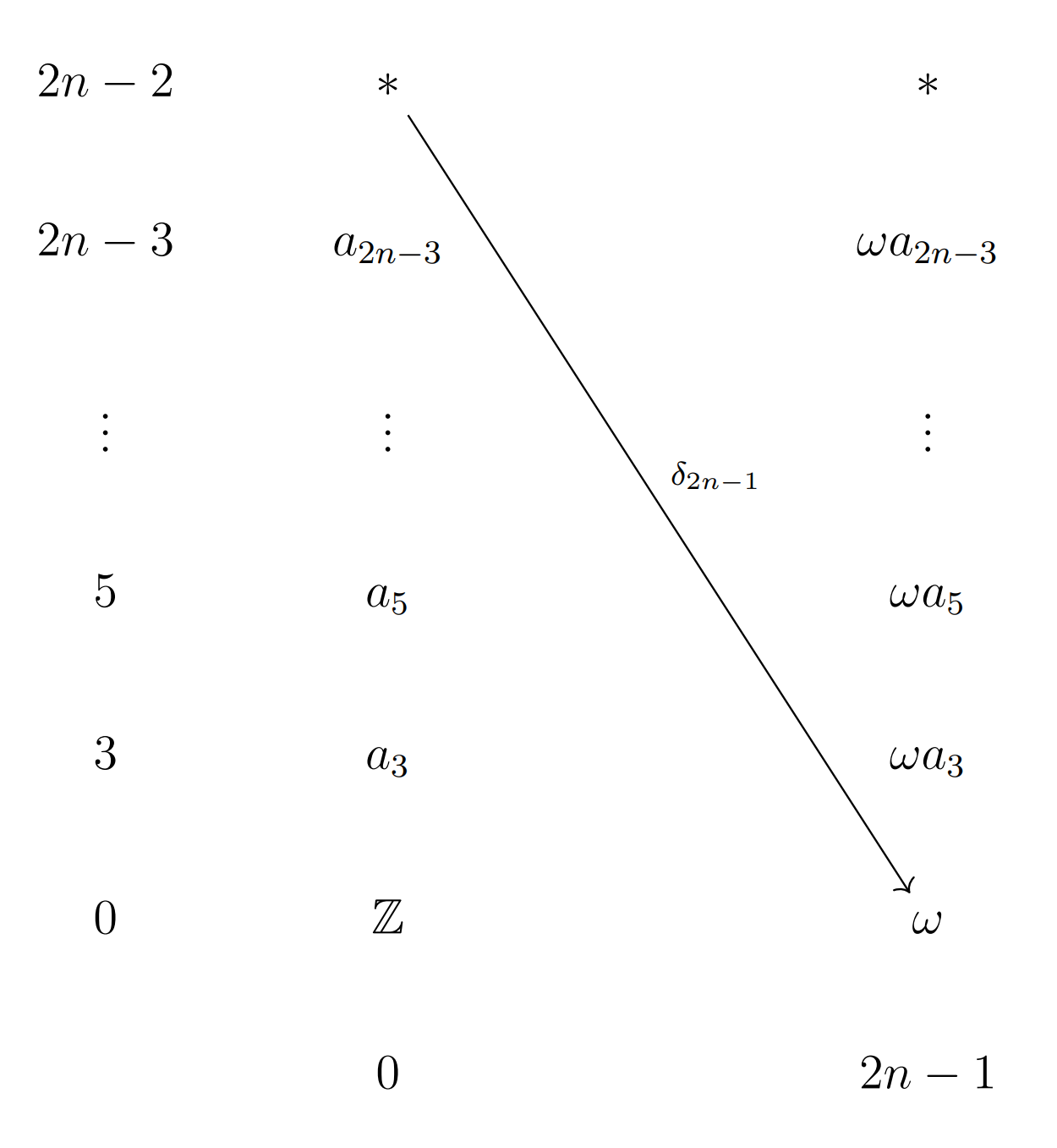
谱序列如下图所示,
唯一一个可能非零的$\delta_{2n-1}$由导子性质也是零(通过分解).
从而谱序列从$E_2$开始就停止.
$$
E_\infty=E_2=H^\ast (S^{2n-1})\otimes \Lambda^\ast (a_3,\cdots,a_{2n-3})=\Lambda^\ast (a_3,\cdots,a_{2n-1}).
$$
新加的生成元对应于$H^{2n-1}(S^{2n-1})$的生成元.
注意到$\Lambda^\ast (a_3,\cdots,a_{2n-1})$是一个自由代数, 延展问题是平凡的,
从而
$$
\bigoplus_i H^i(SU(n))\cong \bigoplus_i\bigoplus_pG_pH^i(SU(n))=\bigoplus_i\bigoplus_p E_{\infty}^{p,i-p}.
$$
定理 5. 若$E_\infty$是自由的分级交换双分级代数, 那么$H^\ast \cong E_\infty$为代数同构.
边同态
假设$E_2\Rightarrow H^\ast $为第一象限, 那么
$$
E_\infty^{0,q}\hookrightarrow \cdots \hookrightarrow E_3^{0,q}\hookrightarrow E_2^{0,q}
$$
$$
E_2^{p,0}\twoheadrightarrow E_3^{p,0}\twoheadrightarrow \cdots\twoheadrightarrow E_\infty^{p,0}
$$
进一步,
$$
E_\infty^{0,q}=G_0H^q=\frac{F_0H^q}{F_1H^q},\quad H^q\twoheadrightarrow E_\infty^{0,q};
$$
$$
E_\infty^{p,0}=G_pH^p=\frac{F_pH^p}{F_{p+1}H^p=0}, \quad E_\infty^{p,0}\hookrightarrow H^p.
$$
可以定义边同态研究两者的关系.
文章最后更新于 2022-09-29 16:15:30
Basic concepts
Cohomology spectrum sequences are similar to cohomology spectrum sequences, except that the arrows are reversed. In general, we have:
The inclusion relationship of the filtrations on the cochain complex will be reversed, that is
$$
F_pC^\ast \supset F_{p+1}C^\ast .
$$
This gives the spectral sequence $(E_r^{p,q},\delta_r),$ $E_1^{p,q}=H^{p+q}(G_pC^\ast ).$
The spectral sequence converges to $E_\infty^{p,q}=G_pH^{p+q}(C^\ast )$ if the filter sequence is bounded for each $C^i$.
multiplicative structure
Assume $(C^\ast ,\delta)$ has a multiplicative structure (itself satisfies the operation law such as associative law, etc.),
$$
\cup:C^i\otimes C^j\rightarrow C^{i+j},
$$
We want it to be compatible with differential and filtrations,
This way it can be placed on the spectral sequence.
Compatibility with differentials requires that it be a derivative:
$$
\delta(\alpha\cup \beta)=(\delta\alpha)\cup \beta+(-1)^i\alpha\cup(\delta\beta),\quad \alpha\in C^i.
$$
Compatibility requirements with filtrations:
$$
\cup:F_pC^\ast \otimes F_{p'}C^\ast \rightarrow F_{p+p'}C^\ast .
$$
Thus $\cup$ induces (inductively) a well-defined multiplication on the spectral sequence:
$$
\cup_r:E_r^{p,q}\otimes E_r^{p',q'}\rightarrow E_r^{p+p',q+q'}.
$$
Proposition 1. $\delta_r$ is a derivative on $E_r^{p,q}$, that is:
$$
\delta_r(\alpha\cup_r \beta)=(\delta_r\alpha)\cup_r\beta+(-1)^{|\alpha|}\alpha\cup_r(\delta_r\beta),\quad |\alpha|:=p+q,\quad \alpha\in E_r^{p,q}.
$$
Proposition 2. If the filtration is bounded for each $C^i$, then the multiplicative structure on $E_\infty^{p,q}$ is compatible with the natural multiplicative structure on $G_pH^{p+q}(C^\ast )$.
We say that $E_r$ is an algebraic spectral sequence if it has a multiplicative structure.
Leray-Serre cohomology spectrum sequence
For Serre fibrosis, $B$ road connectivity,
$$
F\rightarrow E\xrightarrow{\pi} B
$$
For a commutative ring $R,$ $H^\ast (F;R)$ is a (graded commutative) $R$ algebra,
$E_2^{p,q}=H^p(B;H^q(F;R))$ is a $R$ algebra, $E_r$ is an algebraic spectral sequence,
$E_\infty^{p,q}=G_pH^{p+q}(E;R).$
Note 3. If $\cup$ represents the standard multiplication structure on $H^\ast (B;H^\ast (F;R))$, and $\cup_2$ is the multiplication structure on $E_2^{p,q}$, then
$$
\alpha\cup_2\alpha'=(-1)^{qp'}\alpha\cup\alpha',\quad \alpha\in E_2^{p,q},\alpha'\in E_2^{p',q'}.
$$
Our goal is to make $(E_r,\delta_r,\cup_r)$ a differential graded algebra such that
$$
\alpha\beta=(-1)^{|\alpha||\beta|}\beta\alpha,
$$
$$
\delta(\alpha\beta)=(\delta \alpha)\beta+(-1)^{|\alpha|}\alpha(\delta\beta).
$$
Theorem 4. $H^\ast (SU(n))\cong \Lambda^\ast (a_3,a_5,\cdots,a_{2k-1})$ is an algebraic isomorphism (the latter is an external algebra).
Use induction. $n=1$ is trivial. Consider $n\ge 2,$
$$
SU(n-1)\rightarrow SU(n)\rightarrow S^{2n-1},
$$
Consider its construction.
$SU(n)$ can be moved to $S^{2n-1}\subset \mathbb{C}^n$,
The stabilizer of $(1,0,\cdots,0)$ is $SU(n-1).$
Thus $S^{2n-1}\cong \frac{SU(n)}{SU(n-1)}.$
Consider the Leray-Serre spectral sequence,
$$
E_2=H^\ast (S^{2n-1};H^\ast (SU(n-1)))\cong H(S^{2n-1})\otimes H^\ast (SU(n-1)).
$$
The spectrum sequence is shown in the figure below,
The only possible non-zero $\delta_{2n-1}$ is also zero by the derivative property (by decomposition).
Thus the spectral sequence stops starting from $E_2$.
$$
E_\infty=E_2=H^\ast (S^{2n-1})\otimes \Lambda^\ast (a_3,\cdots,a_{2n-3})=\Lambda^\ast (a_3,\cdots,a_{2n-1}).
$$
The newly added generator corresponds to the generator of $H^{2n-1}(S^{2n-1})$.
Note that $\Lambda^\ast (a_3,\cdots,a_{2n-1})$ is a free algebra and the extension problem is trivial,
Thus
$$
\bigoplus_i H^i(SU(n))\cong \bigoplus_i\bigoplus_pG_pH^i(SU(n))=\bigoplus_i\bigoplus_p E_{\infty}^{p,i-p}.
$$
Theorem 5. If $E_\infty$ is a free graded commutative bigraded algebra, then $H^\ast \cong E_\infty$ is an algebraic isomorphism.
edge homomorphism
Assuming $E_2\Rightarrow H^\ast $ is the first quadrant, then
$$
E_\infty^{0,q}\hookrightarrow \cdots \hookrightarrow E_3^{0,q}\hookrightarrow E_2^{0,q}
$$
$$
E_2^{p,0}\twoheadrightarrow E_3^{p,0}\twoheadrightarrow \cdots\twoheadrightarrow E_\infty^{p,0}
$$
further,
$$
E_\infty^{0,q}=G_0H^q=\frac{F_0H^q}{F_1H^q},\quad H^q\twoheadrightarrow E_\infty^{0,q};
$$
$$
E_\infty^{p,0}=G_pH^p=\frac{F_pH^p}{F_{p+1}H^p=0}, \quad E_\infty^{p,0}\hookrightarrow H^p.
$$
Edge homomorphism can be defined to study the relationship between the two.
The article was last updated on 2022-09-29 16:15:30